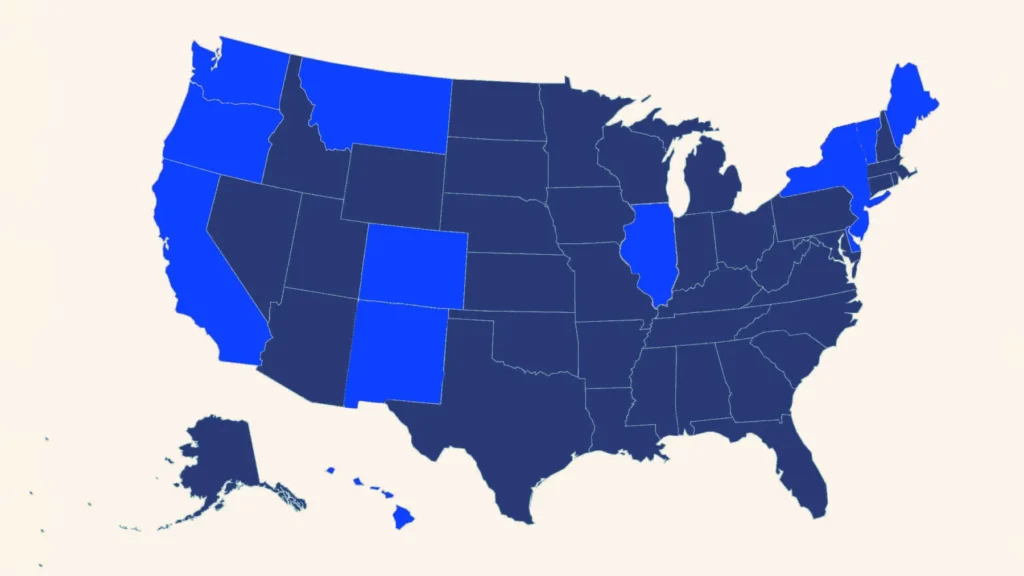
Medical aid in dying is authorized in 14 states and the District of Columbia. 31% of Americans have legal access to medical aid in dying.
California
• Two oral requests ≥48 hours apart; one written request. No waiver for urgent aid in dying.
• Attending and consulting must be physicians
• Must be a state resident, typically proven by a state ID/driver’s license, voter registration, lease/deed, or recent state tax return; Must be present in the state for eligibility evaluations and aid-in-dying day.
• Attending and consulting physicians assess decision-making capacity; if uncertain, they must refer to a licensed mental health professional (psychiatrist or psychologist) for a formal capacity evaluation
California State Statute and information
Colorado
• Two oral requests with ≥7 days between them; one written request; attending may waive the 7 days if the patient is unlikely to survive it.
• Attending and consulting may be physicians or qualified APRNs with prescriptive authority; PAs are not currently listed as attending/consulting prescribers.
• Must be a state resident, typically proven by a state ID/driver’s license, voter registration, lease/deed, or recent state tax return; Must be present in the state for eligibility evaluations and aid-in-dying day.
• Attending and consulting physicians assess decision-making capacity; if uncertain, they must refer to a licensed mental health professional (psychiatrist or psychologist) for a formal capacity evaluation
Colorado State Statute and information
Delaware
• Two oral requests ≥15 days apart; one written request; Prescription no sooner than ≥48 hours after the written request. No waiver for urgent aid in dying.
• Physicians and qualified APRNs may serve as attending or consulting.
• Must be a state resident, typically proven by a state ID/driver’s license, voter registration, lease/deed, or recent state tax return; Must be present in state for eligibility evaluations and aid-in-dying day.
• Attending and consulting physicians assess decision-making capacity; if uncertain, they must refer to a licensed mental health professional (psychiatrist or psychologist) for a formal capacity evaluation.
Delaware State Statute
District of Columbia
• Two oral requests ≥15 days apart; written request; ≥48 hours between written request and prescription. No waiver for urgent aid in dying.
• Attending and consulting must be physicians.
• Must be a DC resident, typically proven by a state ID/driver’s license, voter registration, lease/deed, or recent state tax return; Must be present in DC for eligibility evaluations and aid-in-dying day.
• Attending and consulting physicians assess decision-making capacity; if uncertain, they must refer to a licensed mental health professional (psychiatrist or psychologist) for a formal capacity evaluation.
District of Columbia Statute and information
Hawaii
• Two oral requests ≥5 days apart; one written request; ≥48 hours between written request and prescription. Waiver for urgent aid in dying.
• Physicians and qualified APRNs may serve as attending or consulting.
• Must be a state resident, typically proven by a state ID/driver’s license, voter registration, lease/deed, or recent state tax return; Must be present in DC for eligibility evaluations and aid-in-dying day.
• Mandatory capacity evaluation by a mental health professional (psychiatrist or psychologist) for all patients.
Hawaii State Statute information
Illinois – Implements on Sept 12th, 2026
• Two oral requests ≥5 days apart; one written request. Waiver for urgent aid in dying
• Attending and consulting must be physicians.
• Must be a state resident, typically proven by a state ID/driver’s license, voter registration, lease/deed, or recent state tax return; Must be present in the state for eligibility evaluations and aid-in-dying day.
• Attending and consulting physicians assess decision-making capacity; if uncertain, they must refer to a licensed mental health professional (psychiatrist or psychologist) for a formal capacity evaluation.
Illinois State Statute
Maine
• Two oral requests ≥15 days apart; one written request; ≥48 hours between written request and prescription. No waiver for urgent aid in dying.
• Attending and consulting must be physicians.
• Must be a state resident, typically proven by a state ID/driver’s license, voter registration, lease/deed, or recent state tax return; Must be present in the state for eligibility evaluations and aid-in-dying day.
• Attending and consulting physicians assess decision-making capacity; if uncertain, they must refer to a licensed mental health professional (psychiatrist or psychologist) for a formal capacity evaluation
Maine State Statute
Montana
• No statutory requirements, but the standard of care is to follow the original Oregon law: Two verbal requests, 15 days apart; one written request. No waiver for urgent aid in dying.
• No statutory requirements, but the standard of care is to follow the original Oregon law: Attending and consulting must be physicians.
• No statutory requirements, but the standard of care is to follow the original Oregon law: Must be a state resident, typically proven by a state ID/driver’s license, voter registration, lease/deed, or recent state tax return; Must be present in the state for eligibility evaluations and aid-in-dying day.
• No statutory requirements, but the standard of care is to follow the original Oregon law: Attending and consulting physicians assess decision-making capacity; if uncertain, they must refer to a licensed mental health professional (psychiatrist or psychologist) for a formal capacity evaluation.
Montana Supreme Court Decision
New Jersey
• Two oral requests ≥15 days apart; one written request; ≥48 hours between written request and prescription. No waiver for urgent aid in dying.
• Attending and consulting must be physicians.
• Must be a state resident, typically proven by a state ID/driver’s license, voter registration, lease/deed, or recent state tax return; Must be present in the state for eligibility evaluations and aid-in-dying day.
• Attending and consulting physicians assess decision-making capacity; if uncertain, they must refer to a licensed mental health professional (psychiatrist or psychologist) for a formal capacity evaluation.
New Jersey State Statute and information
New Mexico
• One oral and one written request; 48 hours between the written request and the prescription. Waiver for urgent aid in dying.
• Physicians and qualified APRNs may serve as attending or consulting.
• Must be a state resident, typically proven by a state ID/driver’s license, voter registration, lease/deed, or recent state tax return; Must be present in the state for eligibility evaluations and aid-in-dying day.
• Attending and consulting physicians assess decision-making capacity; if uncertain, they must refer to a licensed mental health professional (psychiatrist or psychologist) for a formal capacity evaluation.
New Mexico State Statute and information
New York – Implements August 2026
• One oral request and one written request. Once the attending prescriber writes the aid-in-dying prescription, there is a mandatory 5-day waiting period before the pharmacy can fill it; this interval cannot be waived.
• Attending and consulting must be physicians.
• Must be a state resident, typically proven by a state ID/driver’s license, voter registration, lease/deed, or recent state tax return; Must be present in the state for eligibility evaluations and aid-in-dying day
• Mandatory capacity evaluation by a licensed mental health professional (psychiatrist, psychologist, or neurologist).
New York State Statute
Oregon
• Two oral requests ≥15 days apart; one written request; ≥48 hours between written request and prescription. Waiver for urgent aid in dying.
• Attending and consulting must be physicians.
• Accepts out-of-state residents. Must be present in the state for eligibility evaluations and the aid-in-dying day.
• Attending and consulting physicians assess decision-making capacity; if uncertain, they must refer to a licensed mental health professional (psychiatrist or psychologist) for a formal capacity evaluation.
Oregon State Statute and information
Vermont
• Two oral requests, 15 days apart. One written request. No waiver for urgent aid in dying.
• Attending and consulting must be physicians.
• Accepts out-of-state residents. Must be present in the state for eligibility evaluations and the aid-in-dying day.
• Attending and consulting physicians assess decision-making capacity; if uncertain, they must refer to a licensed mental health professional (psychiatrist or psychologist) for a formal capacity evaluation.
Vermont State Statute and information
Washington
• Two oral requests ≥7 days apart; one written request; ≥48 hours between written request and prescription. No waiver for urgent aid in dying.
• Physicians, ARNP, or PAs may serve as attending or consulting. One of the 2 roles must be a physician.
• Must be a state resident, typically proven by a state ID/driver’s license, voter registration, lease/deed, or recent state tax return; Must be present in the state for eligibility evaluations and aid-in-dying day
• Attending and consulting physicians assess decision-making capacity; if uncertain, they must refer to a licensed mental health professional (psychiatrist, psychologist, independent clinical social worker, advanced social worker, mental health counselor, or psychiatric advanced registered nurse practitioner) for a formal capacity evaluation.
Washington State Statute and information